Tuesday, 24 July 2018

Reasons to be an ANDROID DEVELOPER


Reason #1 Open source code – Make what you want

The best part about Android operating system is its feature of being open source. More than before, a lot of electronic manufactures like Samsung, HTC & Asus (to name a few!) have got access to the code which makes it easy for them to use it in their smartphones.
According to IDC, the global share of Android in Smartphones is going to peak in 2015! Here is a detailed forecast:
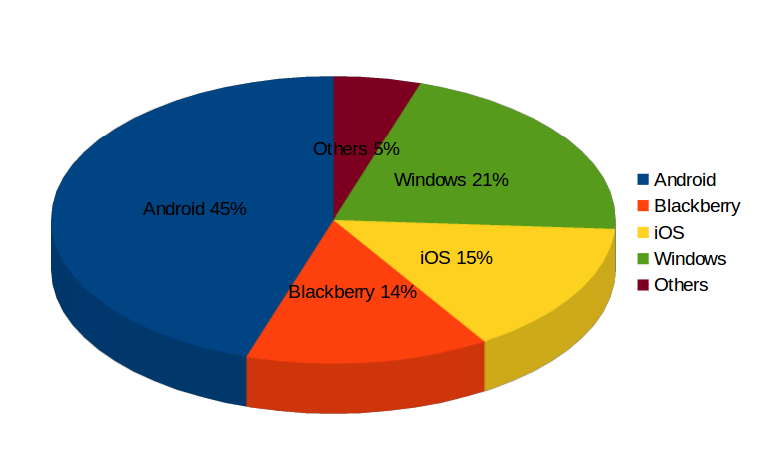
Android Global Market Share
Since a lot of Android devices are getting more efficient and affordable, the size of the market is expected to grow. This goes to the extent where different versions of Android itself have been rolled out through companies like Cyanogen which rolled out Cyanogen mod (One plus one & Micromax Yu Yureka anyone?).

Reason #2 Google Play Store– The Huge App Market

Every since Google rolled out its play store, the joy of experiencing app has only multiplied tenfold. There was a time when we all looked up to the iTunes store from Apple and sometimes getting an iphone was nearly impossible. But with the Google play store and Android smartphones access to apps has become so easy for all.
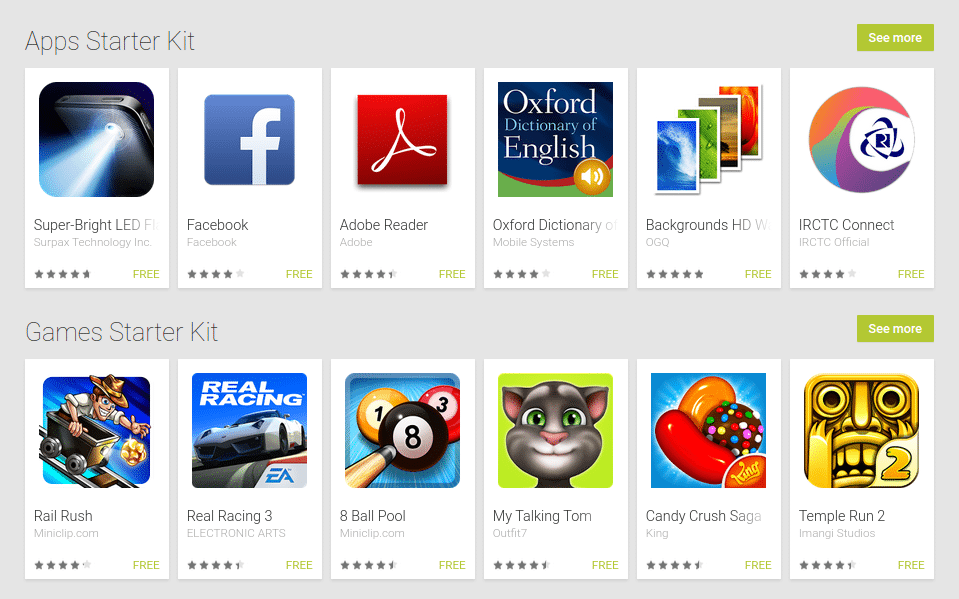
Google Play Store 2015

Let’s look at some numbers…
  • Android is the primary OS for 300 Smartphones, 90 Tablets & 6 E-Readers
  • Everyday around 1.5 million Android devices are activated across the globe.
  • There are over 1,460,800 apps in Google Play store & growing!
  • Over 60% of Android apps are for free!


Reason #3 Booming Job Prospects

As Android provides an interesting revenue model, a lot of organizations have a dedicated team for application development with hiring catching pace. The unique advantage of learning app development is that learners can choose to work or freelance. Similarly, once that person masters developing apps through Android it becomes easy to develop apps for other operating systems!
The graph below is just an assumption of a person having knowledge of Java and where he/she could go from there.

How Application developer is better than other IT jobs

Here it clearly shows that application development is one of the promising career paths for professionals who just love creating apps.

Reason #4 Revenue Model

Did you know that the costliest app in Google play store is the Abu Moto collection app for $200! Weird but true. This app is especially made for rich people. More of that later, but the fact that Google allows developers to price their apps in the Google play store even at such higher prices makes it quite rewarding.
Imagine that you are creating an app for roughly $1 and you launch it in Google and there are over 1.5 million Android devices activated each day! How much can you make even if 1% of the total Android users downloaded your app? You do the math…

$1 X 1% X 1.5 Million = $15,000 !

Different Models of Payment:

App Download – Once the app is launched in the Google play store, the app developer can fix a price for the app and post download, Google will pay out after deducting play store charges.
Ad-Revenue – This model is quite common for free apps where Google will pay out to developers in exchange for placing ads in the app. A lot of developers have benefited from this model.

Reason #5 Penetration on Different devices

Android is everywhere. Let’s face it. Recently, the Moto 360 got launched to compete with Apple Smartwatch and then there is the Google glass powered by the Android operating system. Staggeringly, the total number of Android devices sold is 1,175,450,000!
Some of the devices supported include Smart TVs, Smartphones, Tablets, Portable Media Players, Camera, VoIP Phones, Video game player, Car DVD Player, Car Systems, Smartwatches and even Drones…

What’s in for the developer?

It’s simple. Different devices offer different opportunities! Smart TV customers for example will have different expectation than Smartphone users when it comes to apps. Taking cue from this small insight, app developers can launch apps for each type of customer segment thereby widening their base and increasing their revenue many times.


Reason #6 Gradual Learning Curve

There is a lot of inhibition among Android app developers over what they need to learn in order to develop Android apps. One has to agree that the person must be innovative, identify opportunities in the market and develop new ideas. But apart from that, here are some important skills:
Java – It’s important to know Java because the Android applications have Java coding in it.
XML – Secondly, XML is the second most important skill for Android app development since it enables you to work on the app layout and design.
There is a free tutorial that might interest you to get started with app development with Android Lollipop. 


_____________________________________________________________________________________________________


Friday, 20 July 2018


            ANGULAR JAVASCRIPT                                            (reasons to learn)                               

1. AngularJS Manages Dependencies:

AngularJS performs quite well in terms of dependency injection. With the support of libraries like, RequireJS, the user can dynamically load the JavaScript whenever needed. Single Page Applications and Testing are the two major scenarios, which prove the worth of dependency injection.
In the case of testing, AngularJS allows splitting the applications into separate logical modules, which can possess dependencies on other modules. This feature can allow you to have strategic tests by carrying only the logical modules, which you’re interested in. With the dependency injection, you can able to swap the existing $HTTP service of Angular with the new $HTTP Backend mock for testing. This facilitates real unit testing, which does not trust on services to render. It also allows the end-to-end testing as well.
Single Page Applications utilize dynamic loading in order to offer a native application experience from a web-based application. These applications can enhance rapidly with plenty of dependencies on a wide range of modules and services. Angular present what you need to manage the object’s lifetime for you. With the excellent dependency handling, there is no need to depend on un-maintainable main() to execute the code. It reduces the backend server burden largely that make the applications faster and lighter. The following image shows an overview of dependency injection:

2. AngularJS Provides an Absolute Client Interface:

This framework utilizes HTML to describe the client interface application. HTML (Hyper Text Markup Language) is a descriptive language that is less complex and more natural when compared with describing the client interface procedurally in JavaScript. You can have countless of UI engineer when the interface is characterized in HTML.
HTML is mainly used to focus on the application execution. If you want to get rid of conventional coding and like to describe what you want, it is best to deal with Angular.


3. High Performance:

Robust, easy maintenance, effectiveness to integrate with new features, ease of access and intuitive features are some of the benefits, which makes the JavaScript framework most popular choice among the web developers across the world. There is no doubt that every developer wants to reduce the amount of time that makes him or her spend on the debugging code crisis. At the same time, they are searching for the methods to perform minor modifications with extra convenience and ease access. AngularJS is the framework that offers these for the web developers. It requires minimum maintenance; since, it comes with advanced features like Routing, Form Validation, API client, Filters, scope management, I18N, data binding, animations and directives to create it most simple as well as fast to make web applications.

4. Filters offer Flexibility:

As we all know, Filters are standalone functions like directives which are responsible for filtering the data prior it touches the view. Filters are generally separate from the application and include in processes like implementing pagination, text string reversing and arranging decimal places on the numbers. Developers utilize filters in controllers, services, view templates and directives. They are flexible as well as resourceful, which can even categorize the HTML table without using any JavaScript.

5. Reduced Line Coding:

Every Web Developer looks for different ways to reduce the size of codes. With Angular JS, there is no need to compose MVC pipeline. With the HTML, the information models are simpler to develop without using getter and setter. In addition, there is no essential to place details into the standpoint physically, which is popularly known as information tying. The channels allow you to handle details on the standpoint level without altering the controllers.

6. AngularJS Facilitates Immensely to Parallel Development:

The major problem a Web Developer encountered in the earlier project was depending on each other. Of course, with the support of JavaScript, it is possible to use patterns, which allows it modular. However, the Angular JS brings it to the next level. It does not mean that AngularJS completely removes dependencies; however, it makes them simpler to handle. A massive grid present in the application allows you to drive plenty of key operations. With Angular JS, the developers can independently code and test the own services without stepping into other services as often.

Thursday, 19 July 2018


WHY LEARN JAVA PROGRAMMING  


While you dream to have a fantastic career in IT, the hands-on experience and expertise in Java Programming Language is that essential requirement which goes without saying. Now, there must be a question hovering in your mind that “Why should I learn Java Programming Language?”

Well, as we only make you think about this question, we only give the answer. But, before anything else, let’s gets ourselves detail you about Java.

=)  What is Java?
A peer of C++ and Smalltalk, Java is an object-oriented programming language which came into existence in the year 1995. The credit to develop this programming language goes to Sun Microsystems. Since its debut to the world of computers, this programming language is changing the face of IT and its related field.
From web to mobile, electronic appliances to servers, Java is used everywhere. This highly secure language sits at the heart of world’s most robust systems at present. That’s what keeps Java an evergreen winner in the world of programming languages.

=)  How to learn Java Programming language?

While the significance of Java is everywhere, gaining the expertise over this programming language is quite easy. You can learn this as it is one of the most talked about and implemented programming language from Java certification training institutes and getting a certification to get the proof of your knowledge.
Seeing the importance of Java in today’s epoch, many organizations claim to provide Java related course but they fail to fulfill what they claim. So make sure you choose a good training center only. It is required that you take Oracle certification which is the best Java Programming Certification at present. We recommend you to take Java SE 7 and SE 8 OCAJP exam and prepare well for it.

=)  Why learn Java?


Though there are numerous reasons behind the learning of Java, we have hand-picked the most imperative ones for you:

1. A wide-spared job pool

Why do we learn? To earn, right? Java, being the most acclaimed skill, is in demand almost everywhere. Big players like IBM and Infosys are in constant need of Java programmer. You can also update your set of skills by doing Oracle certification course. In addition, the high paycheck at the end of the moth is another motivational factor. As per Payscale, a Java Developer takes an average salary of $69,722 in a year’s time.

2. Varied job roles

Java’s implementation in systems is vast so it its demand. You can enjoy working with varied job roles with Java. Profiles such as Software Developer, Web Developer, Web Programmer, and Application Developer are amongst a few. Owing to such diverse role, an individual has a number of options to choose from. You can switch or add-on to proficiencies as you progress.

3. Global presence and demand
A skilled Java professional has the whole globe to work over as the demand is not limited to a particular geography. Mobiles, laptops, and desktops, you name it and Java would be there so would be Java programmer. On the same note, Java is gaining momentum in the arena of the Internet of Things (IoT) which is the next budding technology.

4. Open-source IDE
Java is an open source ‘learning’ language and you need to spend a single penny to work under Java. You can write, develop and execute applications absolutely free with Java. What else could you ask for?

5. The rich and competent API
Rich API is one of the most crucial factors behind the success of Java. Java API is highly flexible and can be coupled with ant set of tools and application to perform actions.


________________________________________________________________________


Wednesday, 18 July 2018


    ENG beat IND by 8 wickets, clinch                             series 2-1


England beat India by eight wickets to win the third one-day international at Headingley on Tuesday for a 2-1 series win in the three-match contest. Chasing a target of 257, England rode impressive knocks from Test skipper Joe Root (100 off 120 balls) and Eoin Morgan (88 off 108 balls) as the duo shared a match-winning 186-run unconquered stand. Earlier, Virat Kohli scored 71 off 72 balls, inclusive of eight fours, but the Indian innings faltered in face of some quality spin bowling by Adil Rashid, who snapped 3 for 49 to hurt the middle order. Left-arm medium-pacer David Wiley (3/40) also claimed three wickets to contribute to his team.


5 reasons why India lost ODI series against                            England


1. Absence of Bumrah and Bhuvaneshwar Kumar

India's pace bowling got exposed, particularly in the second ODI where they couldn't keep the pressure after spinners did a good job. Lack of Bumrah meant India couldn't finish strongly. Bhuvi came back for the last match but was a shadow of himself.


2. England became better at playing Kuldeep Yadav

England showed why they are a world number one side, when they constantly improved against Kuldeep Yadav. Kuldeep who ran through the English defence in the first match getting six wickets, he bagged three wickets for 68 runs in the second match. However, by the third and deciding match, England seem to have got a grip of how to play Kuldeep Yadav. Kuldeep went wicketless conceding 55 runs as England cantered to an easy win.


3. Indian batters failed to fire

In the second and third ODI, the much famed Indian batting order couldn't live up to its potential. In the second ODI, the top 4 could only get 96 runs, virtually sealing the fate of India. Later, MS Dhoni played a bizarre slow innings for which he got booed by Lord's crowd. In the third ODI, Dhawan and Kohli got good starts but they failed to convert it to a big innings. Dhoni did the holding act to ensure India reach a respectable total, but it was always going to be tough to defend against the World No 1 team.


4. Joe Root showed his ODI calibre

At a time, when England team is packed with explosive hard hitters, some having 360 degree shot making range, Joe Root stands out. He is a poised player, who loves playing cricket the old-school way. Nothing wrong with it, except when he doesn't get going and people start to doubt his methods. But against India, he stepped up managing to score two centuries, to bury the demons of getting dismissed by Kuldeep Yadav previously.  


5. England bowlers came back well

After getting severe tapping in the first match, English bowlers showed lot of heart to make a stunning comeback. Plunkett, Willey and Rashid combined superbly to ensure that England come out on top in conditions which actually suited Indian batters more. Rashid especially deserves special credit for bamboozling top order batters.


________________________________________________________________


5. England bowlers came back well5. England bowlers came back 5. England bowlers came well

5. England bowlers came bac


Tuesday, 17 July 2018

FRANCE WINS WORLD CUP ..... CROATIA WINS HEARTS

       FRANCE WINS WORLD CUP                 CROATIA WINS HEARTS


FIFA Football World Cup 2018 Winner France defeating Croatia 4-2 in an epic final in Moscow bringing curtains down. Not surprisingly, the epic match resulted in a deluge of memes, contributing to the FIFA frenzy on Twitter. Moreover, while many commemorated France’s win, others also appreciated Croatia for their performance in this world cup. The match between the two countries remained quite intense all throughout, even though France kept a lead of 2-1 till half time. A major boost for France in the first half was an unexpected own goal by Mario Mandzukic, which gave them an immediate lead, followed by a penalty that, where they scored again. 


While Croatia gained momentum with Mandzukic scoring in the second half and touching the 4-2 score but it wasn’t much to pull the team through the second half. Though, the team tried really hard but failed to even score a third. France scored through Paul Pogba and Kylian Mbappe before a Hugo Lloris blunder helped Mandzukic make amends for his earlier transgression. All three goals in the second half came in a crazy 9-minute period. France lifted the World Cup for the second time and Croatia once again couldn’t beat the French side.


  Atrocious defending in the penalty box cost             Croatia their first World Cup trophy


Croatia's defence has earned plaudits during the course of the 2018 World Cup. The defensive quartet of Vrsjalko, Lovren, Vida and Strinic have put in some splendid performance keeping the attacks of Denmark, Russia and England at bay. Although Croatia kept their shape in the first half, they were undone by some shoddy defending by their forwards in the penalty box and the Croatian defence failed to marshal their troops in the penalty box which led to costly errors. They were punished in the 18th minute after Mario Mandzukic failed to clear the ball and instead slotted the ball past his own keeper, giving France the lead. Although Croatia pegged back through Ivan Perisic's equalizer, they were undone yet again after Perisic handled the ball in his own box from an Antoine Griezmann corner in the 36th minute. VAR spotted Perisic handling the ball and Griezmann calmly scored from the penalty spot, sending Subasic the wrong way. Finals are won and lost during such moments and Croatia suffered from two calamitous mistakes on the night. This gave France an upper hand which resulted in the French piling more misery on the Croatians in the second half, with the game finishing 4-2 in favour of France.


_______________________________________________________________


Tuesday, 10 July 2018

      JIO AFFECT - Airtel revised Rs 499                               postpaid plan

        
      Now to offer 75 GB of high-speed data a month


As the telecom war between Airtel, Jio and Vodafone continues to wage, it’s the subscriber who ultimately benefits. In what could be seen as a minor windfall to Airtel users, the company has updated its Rs 499 PostPaid myPlan Infinity plan to offer 75 GB of high-speed data a month. The earlier version of the plan offered 40 GB of high-speed data. A few days earlier, the 649, 799 and 1,199, offering 90 GB, 100 GB and 120 GB of data respectively. In contrast, Jio’s Rs 799 pre-paid plan offers 5 GB of high-speed data every day (or about 140 GB a month).


Under the new Airtel Rs. 499 plan, apart from the 75GB of data per month, the revamped offer is said to include 100 SMS messages, unlimited voice calls, even on outgoing while roaming, and without any FUP limit, reports TelecomTalk. This postpaid plan is said to provide 3G/ 4G data with rollover facility up to 500GB, meaning the unused data of one month gets added on to the next one. Additionally, the Rs. 499 pack reportedly also comes with a few other benefits that remain the same as before. Airtel subscribers can avail a one-year subscription to Amazon Prime. The Rs. 499 unlimited plan is said to also come with Wynk TV subscription, access to its library of Live TV and Movies, and Handset Damage Protection. Notably, the revamped Rs. 499 plan appears to be available to select users in some regions. We can expect a wider rollout in the coming days. Meanwhile, as mentioned, the other postpaid plans remain unchanged, but we can expect Airtel to refresh the lineup with additional data benefits.


                    COMPARISON

In terms of offers from competitors, Vodafone recently revamped its Red postpaid plans priced between Rs. 399 and Rs. 2,999, to provide unlimited calls and more data to its subscribers. Under the new plans, users will get up to 300GB of data, Netflix and Amazon subscriptions, and more. The telco also announced a new Rs. 299 Red Basic postpaid plan that comes with 20GB of data. For comparison, Jio's Rs. 199 postpaid plan gives the user a total of 25GB 4G data, free unlimited voice calls, 100 SMS messages, and complimentary access to Jio's entire suite of apps for a standard bill cycle. Users can avail additional data at Rs. 20 per GB for the next 500GB. This plan entails a security deposit of Rs. 250 which is 100 percent refundable, and Jio Prime membership worth Rs. 99.


_________________________________________________________________________________


Monday, 9 July 2018

Samsung Sets Up 'World's Largest Mobile Factory' in Noida

Samsung Sets Up 'World's Largest Mobile                     Factory' in Noida


In front are open fields with grazing cattle, to the left are under-construction residential societies and to the right is its existing facilty - this is where Samsung has set up what is the world's largest mobile factory. Not China or South Korea - and certainly not the US - the tag of housing the world's largest mobile factory has straight away put Noida on top of the world manufacturing map when it comes to consumer electronics. 


The new 35-acre Samsung Electronics facility at Sector 81 in Noida, Uttar Pradesh, will see Prime Minister Narendra Modi and South Korean President Moon Jae-in landing together at a quickly-prepared helipad adjacent to the factory to officially inaugurate it on Monday. One of the first electronics manufacturing facilities set up in the country in the early 1990s, the plant started by manufacturing TVs in 1997. The current mobile phone manufacturing unit was added in 2005. In June last year, the South Korean giant announced a Rs. 4,915 crore investment to expand the Noida plant and, after a year, the new facility is ready to double production. The company is currently making 67 million smartphones in India and with the new plant being functional, it is expected to manufacture nearly 120 million mobile phones. Not just mobiles, the expansion of the current facility will double Samsung's production capacity of consumer electronics like refrigerators and flat panel televisions, further consolidating the company's leadership in these segments. 


According to Tarun Pathak, Associate Director at Counterpoint Research, the new facility gives Samsung an advantage by reducing the time to market. "This will help Samsung bring some local features to the devices powered by R&D here. Apart from this, the company can also bring in export opportunity for Samsung to SAARC and other regions," Pathak told IANS. Samsung has two manufacturing plants - in Noida and in Sriperumbudur, Tamil Nadu - five R&D centres, and one design centre in Noida, employing over 70,000 people and expanding its network to over 1.5 lakh retail outlets. 


Established in 1995, Samsung India laid the foundation stone of Noida plant next year. In 1997, production commenced and the first television was rolled out. In 2003, refrigerator production began. By 2005, Samsung had become market leader in panel TVs and in 2007, the existing Noida facility started manufacturing mobile phones. In 2012, Samsung's Noida facility rolled out the first-ever Galaxy S3 device. The company currently has over 10 percent of its overall production in India and aims to take it to 50 percent over the next three years. "For Samsung, India is among the top five smartphone markets globally. The US is saturated and Korea and Brazil are not growing significantly. India is a big opportunity across price segments, including 2G feature phones. It makes sense for Samsung to build a bigger manufacturing base here," Jaipal Singh, Senior Market Analyst, IDC, told IANS. "They are now looking at building a complete ecosystem. After smartphones, they can go into building top-of-the-line products in other categories like TVs, refrigerators as advance manufacturing in India still lags behind. With the new facility, Samsung is going to have an edge over its rivals," Singh noted. According to HC Hong, President and CEO, Samsung India, a bigger manufacturing plant will help them cater to the growing demand for Samsung products across the country. Samsung India, that registered 27 percent growth in mobile business revenue for the financial year 2016-17 - accounting for a whopping Rs. 34,300 crores of its reported Rs. 50,000 crores sales - won't be able to hide the smile when the new facility kicks off production from July 9.


___________________________________________________________